
Code (un)Enforcement
Lately there has been a lot of hue and cry about local code enforcement, so much so that we feel the issue deserves its own page, not one buried inside our "Development Projects" and "Law Enforcement(?)" pages.
Sacramento County organizes its Code Enforcement Division within the Department of Community Development. The Division says it, "...investigates violations of housing, zoning and vehicle abatement laws in the unincorporated Sacramento County. We work to achieve voluntary compliance through notification and education. When necessary, we use legal procedures including boarding structures, removing junk and rubbish and junk vehicles, civil citations, criminal citations and demolition of dangerous buildings. Our goal is to maintain and improve property values and the quality of life for residents, visitors and business owners." That sounds reasonable enough. But, when you get down in the weeds, things look a little different.
Let's start with housing. The County's Rental Housing program has not exactly earned 5 star reviews. Remember the scathing Bee article about substandard apartments in our community? That was from 10 years ago. Have things gotten better since then? Well, no, at least not if you ask the tenants of the Palms Apartments on Marconi. As we pointed out almost a year ago, the County hides behind state laws that tend to prioritize the rights of property owners above public health and safety. So what, if anything, is the state doing about that? Mostly, all we can see is the stripping away of zoning and environmental considerations, ostensibly to help developers build even more housing units.
Look, we understand that the Legislature is fundamentally clueless about arcane state laws having to do with General Plans and their implementing ordinances. We get that Legislators want simple solutions to solve massively complex problems, even when legislative "reforms" only yield marginal results. Yet the reality remains that lumbering bureaucracies like those of our governmental landlord (Sacramento County, with more than 11,000 employees) cannot translate those marginal results into actions that improve the quality of life for anyone except the most privileged. Why? Well, to be fair, the state doesn't provide money for counties to conform to new laws, even while it actively reduces county revenues on an ongoing basis, as it has done since 1992 with budget-balancing gimmick in that year that shifted property tax money from local governments (cities, counties and special districts) to pay for schools, to the point where by now the state has an "excess-ERAF" slush fund.
Now let's move on to just plain old zoning enforcement. The first thing to understand is that our County Zoning Ordinance has way more holes than Swiss Cheese. That's because the underlying premise is that "the market" should prevail. What about rules that a government might apply to achive a public purpose? Nope. If a rule infringes on an investor's ability to profit - especially a speculative investor - that's a problem. And, lest you think the County's rules are bent just for locals like Buzz Oates or the father of California's Lt. Governor, you should understand that not having rules and just leaving things to "the market" is a benfit for ANY investor, ANY developer - including those whose headquarters are out of the area, out of the state, or out of the country. So it shouldn't surprise anyone that County Code Enforcement is toothless or spotty, nor should anyone be shocked that commercial property gets a pass.
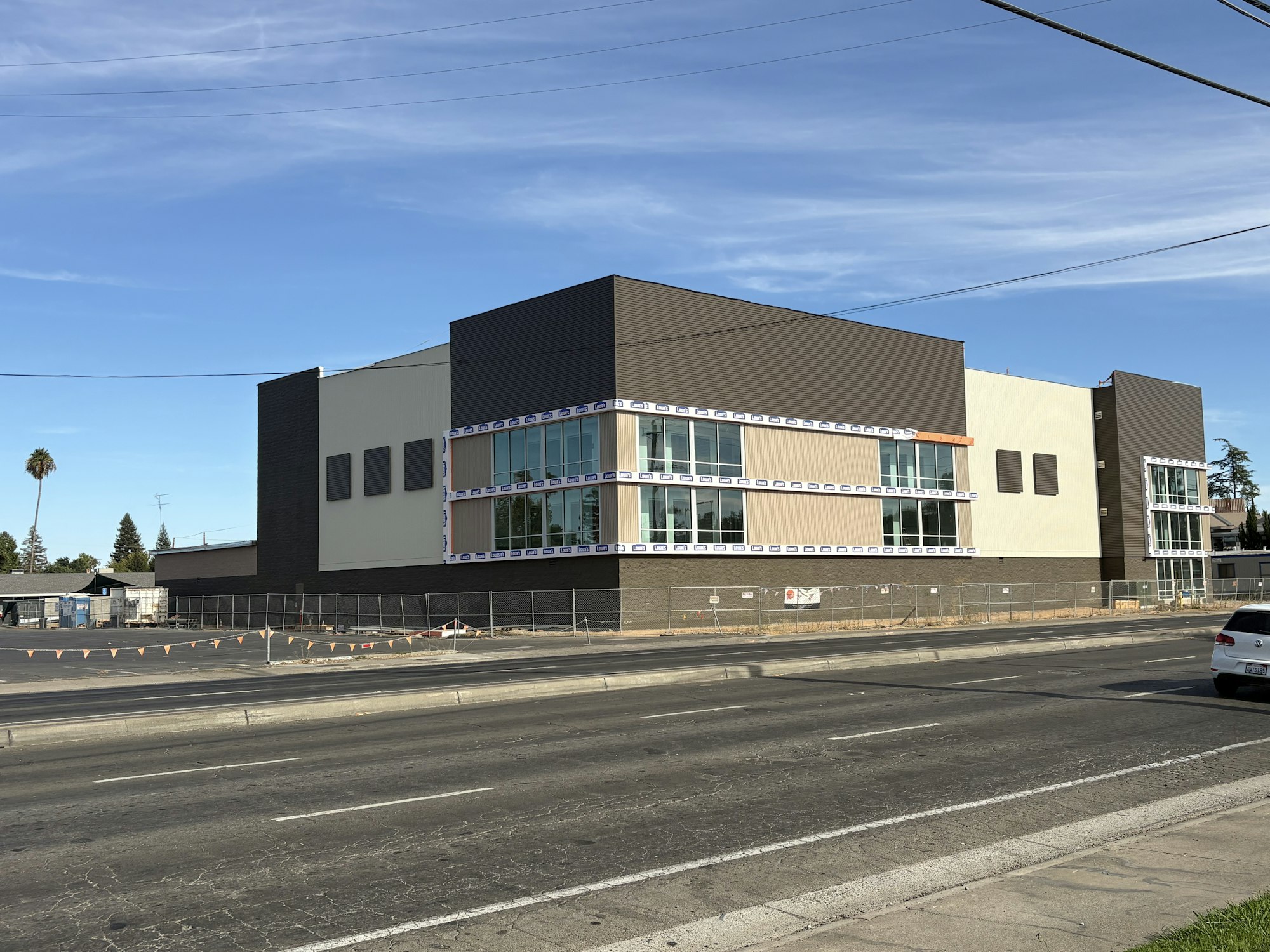
Wait. What? Are we saying it's easy to break or bend the County's rules for land use and development? Yes, we are. Start with the fundamental concept that a General Plan, something required by state law, is a blueprint for the future - it is supposed to guide land use and development projects so they achieve - or do not conflict with - the agreed-upon goals and objectives set by the community via the process laid out in state law as per administrative rules for implementation. Within the County's adopted General Plan are specific plans for unincorporated communities. Arden Arcade's Community General Plan was last adopted in 1980, with a "Community Action Plan" that was adopted in 2006. Both of those documents spoke to the need to protect existing residential areas with "Special Planning Areas" (i.e. stricter oversight), tree plantings and signage aesthetics, all intended to preserve and improve the quality of life. Fast forward to 2026. What actually happened? There has been a big-time downward spiral in our community. Gee, wouldn't you think the land use codes would, at a minimum, have been strictly enforced? The Board of Supervisors - most of whom don't live here - are in charge, so of course the protection of our community was not prioritized. That's why the community spiraled downwards and it is why we are here (see our mission statement).
Adding to the perversion of our community's "blueprint for the future", the County has opened the door to developer mischief with:
- Use permits ("also known as a Conditional Use Permit or Special Use Permit, allows specific land uses in zones not normally allowed for a particular site to ensure that the proposed use is compatible with the surrounding neighborhood."),
- Minor use permits ("typically have less impact on adjacent properties than a Conditional Use Permit, require less intensive review, and may be approved by planning staff, upon compliance with staff recommendations and conditions for approval. Unlike a Conditional Use Permit, Minor Use Permits do not require a public hearing."*),
- Special development permits ("discretionary permit which may be granted by the appropriate authority to provide greater flexibility from and alternatives to development standards, minimum lot area and lot width, and minimum public street frontage in any zoning district"*), and
- Variances (which the County calls "Deviations" and frequently uses despite state law stipulating only occasional use and only under specific circumstances),
- A massive revision of its zoning ordinance (which stipulates what kinds of land uses can occur, where they can be permitted outright, where they can be permitted conditionally, and the development standards - like height, floor area ratios, setbacks, etc.) about 10 years ago that provides enough wiggle room for a developer to do whatever a developer wants pretty much everywhere the developer feels like it, and
- A variety of creative language and tactical application of ordinances to get around rules that would otherwise serve historic preservation, heritage tree retention**, noise pollution control, streetscape design, etc.
{Asides: * indicates direct quotes from the County Planning and Environmental Review Division FAQ page. Did you notice the "flexibility" provided to staff and developers? ** The County once allowed a claim that a Modesto Ash Tree - Fraxinus velutina, a species lucky to live 50-75 years - planted by the subdivider in 1949, hemmed in by concrete and buildings except for a 4'x4' dirt patch, overwhelmed with anthracnose disease, and improperly pruned by its owner for at least 50 years was a "heritage tree". Neighbors sued. The County lost. Soon thereafter the tree was put out of its misery and cut down.}
Every time the County allows developers to bend or break development standards, the public is told that the conditions imposed as part of the approval will be enforced. But loosey-goosey rules do not mix well with enforcement. Enforcement of loosey-goosey rules winds up being loosey-goosey as well, so why bother with enforcement? And that is where all of us matter. We are the ones who must insist that there is a vision for the future of our community to replace the 20-80 hindsight that currently "guides" land development in our community. We are the ones who must insist on even-handed, consistent enforcement. We are the ones who must insist on an acceptable return on investment for municipal services purchased with our tax money. Right?